|
The increasing prevalence of global crises,
including climate change, pandemics, geopolitical conflicts,
mental health challenges, technological disruptions, social
inequalities, and economic uncertainties, has underscored
the need for holistic approaches to human well-being. Spirituality
and consciousness offer transformative pathways for cultivating
resilience, ethical leadership, sustainable living, and collective
flourishing.
Spirituality
At its core, spirituality provides a framework
for meaning that extends beyond material success, helping
people confront the deeper questions of purpose that become
especially urgent during uncertain times. Spirituality is
best understood as an inner resource - a lens through which
individuals, communities, and institutions can relate to purpose,
interconnection, and impermanence, enabling them to face crises
with steadiness rather than fear. This resonates across the
many worlds this conference brings together: for educators
and policymakers shaping systems, for spiritual leaders and
civil society actors working directly with communities, and
for management professionals and psychologists seeking sustainable
models of leadership and care.
Consciousness
Consciousness, the capacity for reflective self-awareness
enables individuals to recognise and transcend habitual patterns
of thought and bias, creating the possibility for mindful,
ethical, and transformative choices.
This has direct bearing on well-being, since much psychological
distress and unsustainable behaviour arise not from a lack
of information but from unexamined mental conditioning. Long
before modern psychology explored these ideas, contemplative
traditions had already developed sophisticated frameworks
for working with the mind.
Patanjali's Yoga Sutra expresses this with precision:

Yoga is the stilling of the fluctuations of the mind
(Yoga Sutra 1.2).
Whether one engages as a researcher, practitioner, policymaker,
or spiritual guide, the understanding that consciousness is
not fixed but can be consciously cultivated provides a unifying
foundation for dialogue across disciplines, professions, and
cultural traditions.

(Bhagavad Gita 2.66)
But an undisciplined person who has not controlled the
mind and senses can neither have a resolute intellect nor
steady contemplation on consciousness. For one who never unites
the mind with the inner self, there is no peace; and how can
one who lacks peace be happy?
Human Well-Being:
Most contemporary frameworks in policy, institutions,
and public discourse continue to measure well-being through
economic and infrastructural markers: GDP, healthcare access,
disaster readiness etc. A more complete understanding of well-being,
however, must also account for its psychological, social,
and existential dimensions: belonging, purpose, and inner
stability. Traditions of thought across cultures offer an
expansive vision of this idea, captured in the ancient invocation.
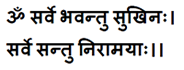
(Sarve bhavantu sukhinah, sarve santu niramayah)
(Brihadaranyaka Upanishad 1.4.14)
May all be happy, may all be free from illness
This reframes well-being as a collective condition rather
than a purely individual pursuit - a perspective with direct
relevance for leaders, policymakers, educators, and community
actors alike, each working to build environments where well-being
isn't siloed but shared.
Era of Global Crises
The present era is defined by a convergence of interconnected
global challenges - climate change, pandemics, ecological
degradation, geopolitical uncertainty, and an unprecedented
rise in mental health concerns. What distinguishes this moment
is not merely the scale of these crises, but their simultaneity
and interdependence, placing extraordinary cognitive, emotional,
and ethical demands on individuals, communities, institutions,
and societies worldwide. In this context, spirituality, consciousness,
and well-being are no longer peripheral or abstract ideals;
they emerge as essential foundations for resilience, responsible
leadership, and sustainable human flourishing.
Addressing these complex challenges demands the very plurality
of perspectives that this conference seeks to bring together:
scholars and students advancing new knowledge; spiritual leaders
and civil society contributing lived wisdom and ethical insight;
and policymakers, management professionals, and practitioners
translating ideas into meaningful action. Through this dialogue,
the conference aspires to foster resilience that is embedded
not only in policies, technologies, and institutions, but
also in the consciousness, character, and capacities of the
people who sustain them.
Chapter 6, verse 17 of the Bhagavad Gita
says

This shloka talks about maintaining a balance in life, in
comfort and effort, in work and sleep, and indulgence and
restriction. It says that those who can walk the fine line
between excess and just enough can remove their problems and
worries with the practice of Yoga.
This 14th edition of the conference seeks to explore how
spirituality and consciousness can contribute to individual
flourishing, ethical leadership, organisational resilience,
societal harmony, and sustainable development. It welcomes
interdisciplinary perspectives from management, psychology,
education, health sciences, philosophy, neuroscience, environmental
studies, and public policy for meaningful exchange and scholarly
engagement.
|